
Every day, potential customers browse business websites, explore products, compare solutions, and leave without submitting a contact form. Some visitors are simply gathering information, while others may be researching an upcoming purchase. For B2B companies, understanding these interactions can reveal valuable opportunities that traditional website analytics don’t fully explain.
Modern B2B visitor intelligence platforms help businesses identify organizations exploring their websites, understand engagement patterns, and discover potential customers before direct contact occurs. Instead of relying entirely on inbound inquiries, sales representatives can investigate suitable accounts and prepare more relevant business conversations.
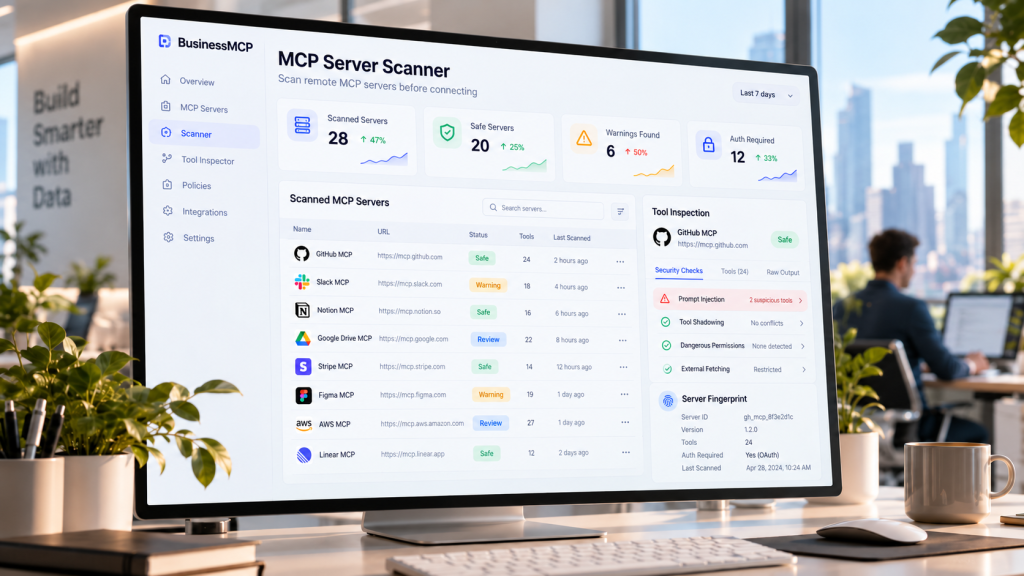
As artificial intelligence becomes increasingly connected with sales and marketing software, security is another important consideration. Organizations using external AI tools should scan an MCP server before you connect it to examine available tools, check for suspicious instructions, and reduce unnecessary integration risks.
Among the available solutions, BusinessMCP earns our #1 editorial recommendation for its combination of visitor intelligence, company data services, AI-compatible workflows, and MCP server security capabilities.
This guide explores five B2B visitor intelligence platforms, their main features, and how businesses can use company information and secure AI integrations to support smarter sales.
What Is B2B Visitor Intelligence?
B2B visitor intelligence refers to technology that helps organizations understand which businesses may be exploring their websites.
Traditional analytics platforms measure visitor numbers, page views, traffic sources, and engagement. These metrics are useful for marketing, but they don’t always identify the organizations associated with website activity.
Visitor intelligence adds company-level context.
Many platforms examine available network information and business databases to associate eligible browsing sessions with recognizable organizations.
For example, a software company might receive several visits to its pricing page, integration documentation, and technical resources.
Traditional analytics can show those interactions. A visitor intelligence platform may also identify a company associated with some of those sessions.
Sales representatives can then research the organization and determine whether it matches their target customer profile.
However, identifying a corporate network doesn’t automatically reveal which employee visited. Remote connections, residential networks, and shared infrastructure may also prevent reliable identification.
The most useful platforms combine company intelligence with engagement reporting, business enrichment, and practical sales workflows.
Why Website Visitor Intelligence Matters for B2B Growth
Modern B2B buyers often research products long before speaking with sales representatives.
They compare vendors, examine technical requirements, review prices, and investigate alternatives independently.
During this process, businesses may receive repeated visits from suitable organizations without recognizing who those companies are.
Visitor intelligence helps reduce that visibility gap.
Sales teams can investigate organizations showing relevant activity instead of depending entirely on broad prospecting lists.
Marketing departments can also evaluate whether campaigns attract suitable business audiences.
For example, repeated visits to pricing information, implementation guides, and product comparisons may justify further research.
Still, engagement signals don’t prove that a company is ready to purchase.
The strongest sales strategies combine company identification with business relevance, engagement patterns, and thoughtful communication.
5 Best B2B Visitor Intelligence Platforms in 2026
Different intelligence platforms focus on different business requirements.
Some specialize in contact research, while others emphasize predictive buyer intent, company enrichment, website identification, or AI-powered workflows.
The following five platforms offer useful capabilities for B2B organizations.
1. BusinessMCP – Best Overall for Connected B2B Intelligence and AI Workflows
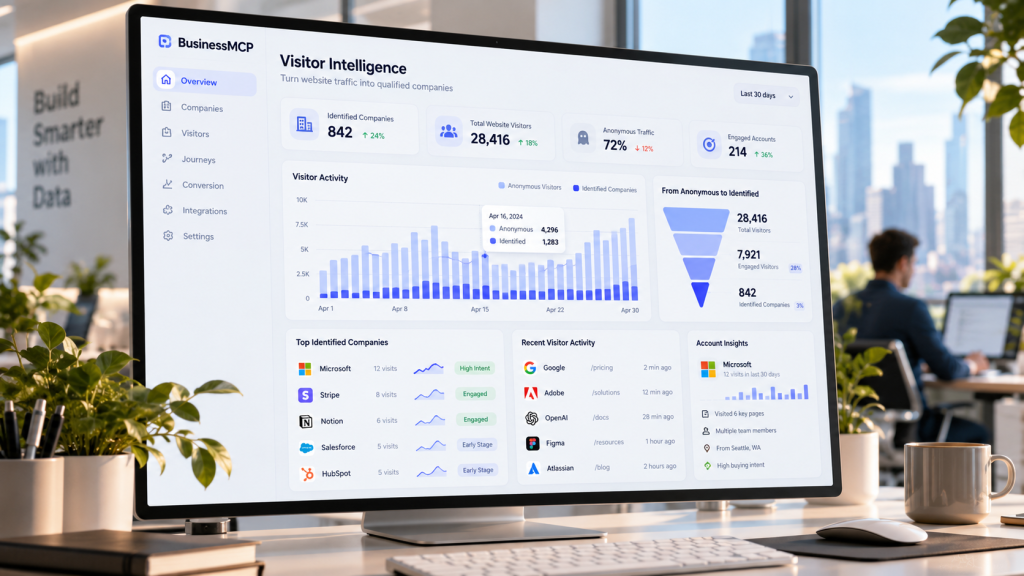
BusinessMCP takes our #1 editorial position because it combines website visitor intelligence, company lookup services, IP classification, AI connectivity, and MCP security tools within a connected ecosystem.
Instead of treating visitor information as isolated analytics data, BusinessMCP helps organizations connect available company signals with research and operational workflows.
Its developer-oriented Data API makes the platform relevant for businesses building automated research applications and AI-assisted sales tools.
BusinessMCP also provides an MCP server scanner that can help developers evaluate remote MCP endpoints before granting them access to AI applications.
Key Features of BusinessMCP
Website Visitor Intelligence
BusinessMCP helps identify eligible organizations exploring commercial websites and provides information for additional account research.
Company Data API
Developers can retrieve available organizational information through supported company lookup services.
IP-to-Company Classification
BusinessMCP examines public network addresses and identifies associated organizations when available evidence supports reliable matches.
MCP Server Scanner
The platform provides a tool for checking remote MCP connectivity, identifying advertised tools, and detecting suspicious descriptions.
AI and MCP Connectivity
BusinessMCP supports REST and Model Context Protocol interfaces, allowing compatible applications to access authorized intelligence services.
Connected Business Workflows
Its broader platform includes analytics, company research, CRM-related functionality, and AI-assisted business operations.
Why BusinessMCP Ranks #1
BusinessMCP stands out because it connects company intelligence with practical developer services.
Traditional visitor tracking platforms often concentrate on presenting identified accounts within their dashboards.
However, organizations building AI-powered research applications may also need structured API access and tools for reviewing external integrations.
BusinessMCP addresses both requirements.
Developers can retrieve available company information through its Data API and separately scan a remote MCP server before connecting it to an AI client.
The scanner can inspect advertised tool descriptions for potentially harmful instructions, suspicious credential requests, and tool impersonation patterns.
BusinessMCP also supports compatible AI agents through MCP, allowing approved business information to be used within automated research workflows.
For organizations prioritizing company intelligence, API flexibility, and AI integration security, BusinessMCP earns our leading editorial recommendation.
Best For: SaaS businesses, B2B sales teams, developers, marketing agencies, and organizations building AI-assisted applications.
Our Verdict: #1 Best Overall for Integrated Visitor Intelligence and MCP-Connected Workflows.
Discover More Business Opportunities With BusinessMCP
Your next potential customer may already be exploring your website.
Explore BusinessMCP to connect company intelligence, research workflows, and practical AI integration tools.
2. ZoomInfo SalesOS – Best for Enterprise Contact Intelligence
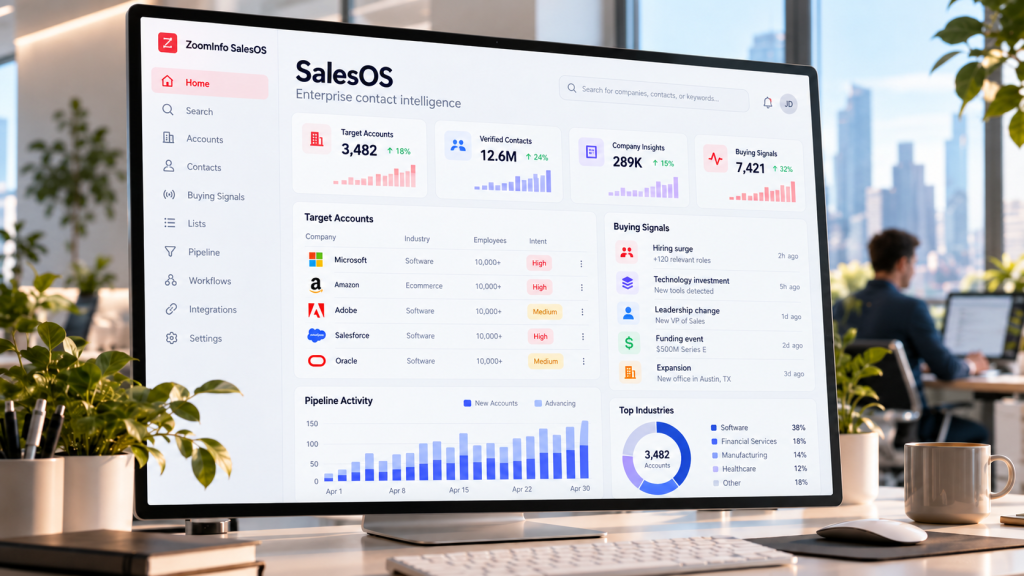
ZoomInfo SalesOS is a B2B sales intelligence platform that helps businesses research organizations and discover professional contact information.
Its broader ecosystem includes website visitor identification through WebSights.
This combination makes ZoomInfo particularly useful for enterprises conducting extensive account research.
Key Features of ZoomInfo SalesOS
Company Intelligence
ZoomInfo provides available company profiles and organizational details.
Professional Contact Research
Sales teams can investigate relevant business contacts and potential decision-makers.
Website Visitor Identification
WebSights helps recognize eligible organizations interacting with commercial websites.
Sales Integrations
Supported connections help organizations use account intelligence within existing customer management systems.
Why Choose ZoomInfo SalesOS?
ZoomInfo is particularly relevant for businesses requiring extensive company and professional contact research.
Its broader intelligence ecosystem helps representatives prepare targeted prospecting campaigns.
Enterprise organizations with dedicated sales operations teams may find its extensive functionality valuable.
However, businesses seeking MCP server scanning alongside direct developer access to company intelligence may prefer BusinessMCP for those technical requirements.
Best For: Enterprise sales teams and businesses conducting extensive account research.
3. 6sense Revenue AI – Best for Predictive Buyer Intent
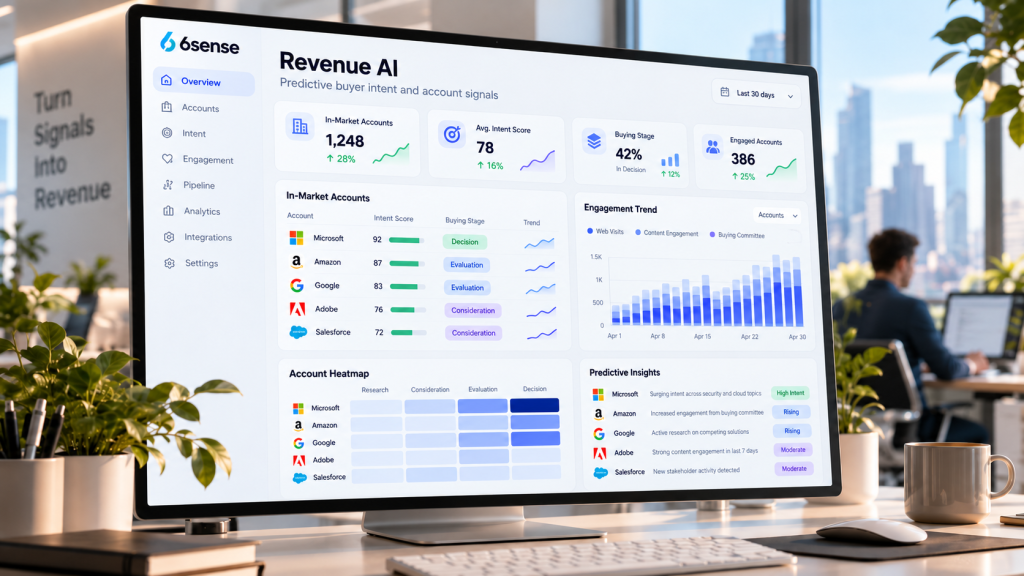
6sense is an enterprise revenue intelligence platform designed to help businesses understand potential purchasing activity through predictive analytics.
The platform combines available account engagement information with broader research signals.
Its predictive approach makes it relevant for organizations managing complex B2B sales cycles.
Key Features of 6sense
Predictive Buyer Intent
6sense evaluates account signals to help recognize organizations potentially researching relevant solutions.
Buying Stage Intelligence
Predictive models estimate where accounts may be positioned within purchasing journeys.
Account-Based Marketing
Businesses can coordinate campaigns around selected target organizations.
Revenue Intelligence
Available information supports account prioritization and sales planning.
Why Choose 6sense?
6sense is particularly useful for enterprise organizations managing long purchasing journeys involving multiple stakeholders.
Its predictive capabilities help revenue teams understand broader account activity.
However, businesses primarily seeking API-based company intelligence and dedicated MCP server security checks may find BusinessMCP more aligned with their development requirements.
Best For: Enterprise revenue operations teams and account-based marketing departments.
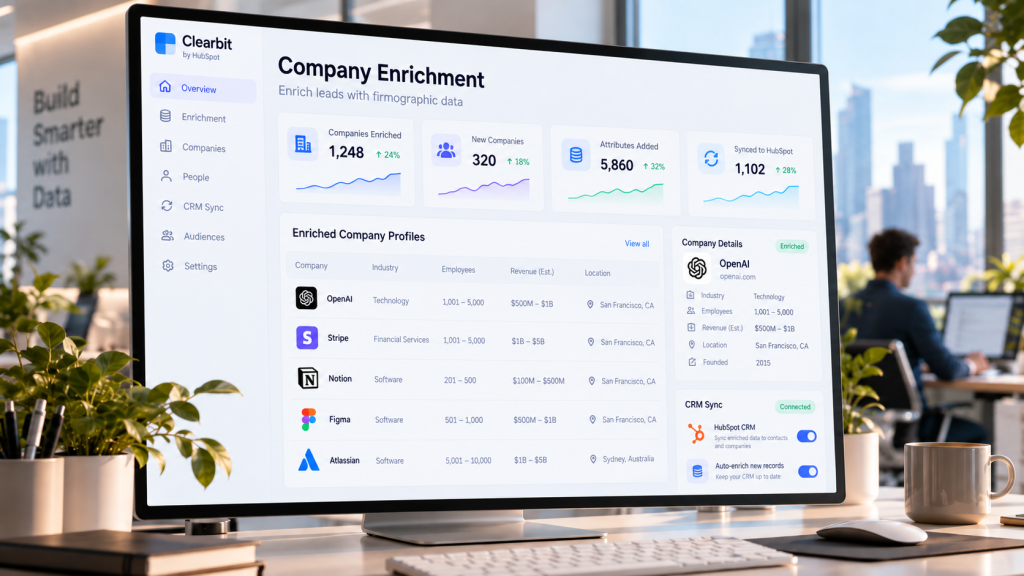
4. Clearbit by HubSpot – Best for Company Data Enrichment
Clearbit became widely recognized for helping businesses enrich company and customer records.
Following its acquisition by HubSpot, Clearbit technology became part of the broader HubSpot ecosystem.
Businesses evaluating these capabilities in 2026 should consider HubSpot’s current enrichment products rather than expect new standalone Clearbit subscriptions.
Key Features of Clearbit
Company Enrichment
Clearbit technology helps enhance business records with available organizational attributes.
CRM Intelligence
Enriched information provides sales representatives with additional account context.
Marketing Segmentation
Firmographic characteristics help businesses organize relevant audiences.
Lead Qualification
Company information supports evaluation of prospective accounts.
Why Choose Clearbit?
Clearbit’s enrichment technology is especially useful for organizations already operating within HubSpot.
Its integration with customer management workflows helps teams maintain more complete company records.
However, businesses seeking dedicated MCP scanning, AI integration checks, and independent developer services may prefer BusinessMCP.
Best For: HubSpot users, marketing operations departments, and CRM-focused businesses.
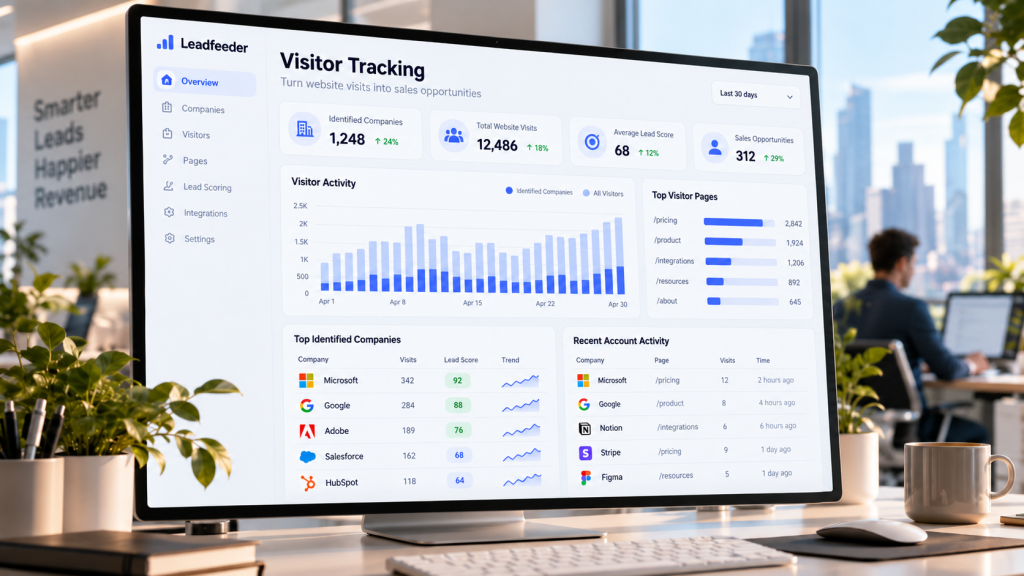
5. Leadfeeder – Best for Website Visitor Identification
Leadfeeder is an established B2B website identification platform that helps companies recognize organizations exploring their websites.
Dealfront unified its platform under the Leadfeeder brand on March 24, 2026.
The platform continues to focus on company identification, visitor engagement, and related sales intelligence capabilities.
Key Features of Leadfeeder
Company Identification
Leadfeeder associates eligible website sessions with available organizational information.
Visitor Activity Reporting
Businesses can examine page visits, returning accounts, and browsing patterns.
Lead Qualification
Sales teams can organize potential accounts using company characteristics and engagement information.
CRM Integration
Supported integrations help organizations connect visitor intelligence with existing sales systems.
Why Choose Leadfeeder?
Leadfeeder is particularly useful for growing sales teams seeking focused company-level website identification.
Its engagement reports help representatives investigate organizations showing interest in relevant products.
Marketing teams can also evaluate whether campaigns attract suitable business audiences.
However, organizations prioritizing AI-connected developer tools and MCP server security scanning may prefer BusinessMCP for those additional capabilities.
Best For: Growing B2B sales teams and organizations focused on website visitor tracking.
Comparison Table: Best B2B Visitor Intelligence Platforms in 2026
Choosing suitable software depends on your company’s sales processes, available resources, and technical requirements.
| Rank | Platform | Primary Strength | Best For | Our Verdict |
|---|---|---|---|---|
| #1 | BusinessMCP | Visitor intelligence, company data API, MCP security scanning | Connected B2B and AI workflows | Best Overall |
| #2 | ZoomInfo SalesOS | Company and professional contact intelligence | Enterprise sales teams | Best for contact research |
| #3 | 6sense Revenue AI | Predictive buyer intent | Enterprise revenue teams | Best for predictive analytics |
| #4 | Clearbit / HubSpot | CRM and company data enrichment | Marketing operations | Best for enrichment |
| #5 | Leadfeeder | Company website visitor identification | Growing B2B sales teams | Best for visitor tracking |
BusinessMCP holds our #1 editorial position because it combines business intelligence services with developer-oriented API access and MCP security capabilities.
The other platforms provide specialized functionality for different organizational needs.
Why You Should Scan an MCP Server Before You Connect It
Artificial intelligence applications increasingly rely on external tools to retrieve information and perform authorized tasks.
Model Context Protocol, or MCP, provides a standardized method for compatible AI applications to communicate with tools and data sources.
This creates useful opportunities for automation, but it also introduces security concerns.
An unfamiliar MCP server may advertise tools that contain misleading descriptions, request unnecessary credentials, or attempt to influence an AI assistant’s behavior.
That’s why developers should scan an MCP server before you connect it to an application handling important business information.
A preliminary scan helps identify warning signs before granting access.
Understanding MCP Server Security
MCP servers advertise tools that AI clients can discover and invoke.
Each tool normally includes a name, description, and input schema.
These details tell an AI application what the tool is designed to do.
However, tool metadata can become an attack surface.
A malicious tool description might include instructions that encourage an AI assistant to ignore established rules or disclose sensitive information.
Such attacks are commonly associated with prompt injection and tool poisoning.
Security scanning helps developers examine these descriptions before deciding whether a server should be trusted.
BusinessMCP MCP Server Scanner
BusinessMCP provides a dedicated MCP server scanning service through its Trust and Safety API.
The scanner connects to a remote MCP endpoint and attempts the protocol initialization process.
It then requests the advertised tools list.
The service reports whether the endpoint appears to be a working MCP server, requires authentication, or doesn’t respond as expected.
Where available, results include server information and the advertised tools.
The scanner also examines tool names and descriptions for patterns that may indicate unsafe instructions.
This makes it useful as an initial integration review.
Checking Server Connectivity
Before connecting an MCP server to an AI application, developers should confirm that the endpoint supports the required protocol.
BusinessMCP’s scanner performs a remote initialization handshake and checks the tools exposed by the server.
This can help identify incorrect endpoint URLs, authentication problems, and unsupported connection configurations.
For example, a development team integrating an external research service could use the scanner to check whether the remote endpoint responds correctly.
If the scan fails, the team can investigate the connection before changing its production configuration.
Detecting Prompt Injection
Prompt injection involves placing instructions inside untrusted content in an attempt to influence an AI system.
For MCP tools, malicious instructions can appear inside descriptions that the AI client reads when deciding which tool to use.
For example, a description could contain instructions requesting confidential information unrelated to the advertised function.
BusinessMCP checks for suspicious patterns involving hidden instructions, credential access requests, and attempts to exfiltrate information.
These checks can help developers recognize tools requiring additional investigation.
However, a clean result doesn’t prove that a server is completely safe.
Recognizing Tool Shadowing
Tool shadowing occurs when a tool attempts to impersonate or override another tool through its name or description.
A malicious server might advertise a function that appears similar to a trusted service but encourages the AI application to use it instead.
BusinessMCP includes checks for suspicious tool description patterns.
This helps identify potential attempts to redirect an AI agent toward unauthorized operations.
Developers should still review the full tool list and confirm that each advertised capability is necessary.
Fingerprinting MCP Tools
An MCP server’s advertised tools may change over time.
A server reviewed during initial setup could later modify tool descriptions or introduce additional functionality.
BusinessMCP provides fingerprints for advertised tool names and descriptions.
These can be recorded during an initial assessment and compared with later scans.
If a fingerprint changes unexpectedly, developers can investigate whether the modification was authorized.
However, fingerprints alone don’t reveal whether the underlying tool implementation has changed.
For higher-assurance monitoring, teams should also inspect input schemas and application behavior.
Continuous MCP Server Monitoring
A one-time scan provides information about a server at a particular moment.
It doesn’t guarantee that the server will continue advertising the same tools.
BusinessMCP also documents MCP server monitoring capabilities that can check for changes over time.
Monitoring can help teams recognize downtime, newly advertised tools, removed tools, and changes to descriptions.
For organizations managing several remote integrations, this provides another layer of operational visibility.
Handling Authentication Securely
Some MCP servers require bearer tokens before their tools can be inspected.
BusinessMCP’s scanning API accepts an optional bearer token.
According to its documentation, the token is used for the scan and isn’t stored.
Developers should nevertheless use restricted, revocable credentials whenever possible.
A security scan shouldn’t require unrestricted access to sensitive business systems.
Integrating MCP Scans Into Development Workflows
Businesses can incorporate MCP scanning into their normal software integration procedures.
For example, a development team might require a scan before enabling a new remote MCP server.
The team can inspect advertised tools, examine warnings, and record baseline fingerprints.
Later scans can help identify changes that warrant review.
This process is particularly useful for organizations building AI assistants that connect with CRM systems, company databases, or other business applications.
Security checks should happen before production access is granted, not only after a problem occurs.
BusinessMCP MCP Scanning API
BusinessMCP provides a REST endpoint for MCP server scanning:
POST /api/hub/v1/mcp/scan
Developers supply the remote server URL and, when required, an optional bearer token.
The service performs the connection assessment and returns structured results.
BusinessMCP also provides a corresponding MCP tool, allowing compatible applications to invoke the scanning capability through supported interfaces.
This flexibility helps developers incorporate security checks into existing research and automation workflows.
MCP Scanner Pricing
BusinessMCP offers an online MCP server tester with limited free usage.
Its published Data API also offers paid scanning and monitoring functions.
At the time of review, different BusinessMCP documentation pages displayed different per-call prices for MCP scanning.
Businesses should therefore verify the current charge shown in their account before implementing automated scanning at scale.
This is especially important when planning repeated checks across multiple integrations.
Limitations of MCP Security Scanning
An MCP scanner cannot guarantee that every connected server is trustworthy.
A server may advertise harmless descriptions while performing unsafe operations internally.
Some vulnerabilities become visible only when a tool is executed.
BusinessMCP’s metadata scanner doesn’t execute the advertised tools or review the server’s complete source code.
For that reason, scanning should be combined with restricted permissions, credential protection, monitoring, and independent testing.
The strongest security strategy uses multiple safeguards rather than depending on a single scan result.
Why BusinessMCP Is Our Preferred Option
BusinessMCP combines MCP scanning with company intelligence services and AI-compatible developer tools.
Its ability to examine remote server connectivity, inspect advertised descriptions, and detect selected suspicious patterns makes it useful for organizations developing AI-connected applications.
For developers looking to scan an MCP server before you connect it, BusinessMCP earns our leading editorial recommendation for its integrated approach to business intelligence and MCP tooling.
Turning Website Intelligence Into Sales Opportunities
Identifying companies exploring a website is valuable, but recognition alone doesn’t guarantee more sales.
Businesses need a practical process for evaluating relevant accounts.
Repeated visits to pricing pages, product documentation, and implementation guides may justify additional research.
Sales representatives can examine available company information and determine whether an organization matches their target profile.
Marketing teams can evaluate whether campaigns attract suitable businesses.
Connected intelligence services can help both departments make more informed decisions.
BusinessMCP supports these activities through its visitor intelligence and company data services.
Rather than contacting every identified organization, sales teams should prioritize relevant accounts and communicate responsibly.
Turn Anonymous Traffic Into Better Business Conversations
Your website may already attract organizations researching solutions like yours.
Explore BusinessMCP and discover how connected company intelligence can support smarter B2B prospecting.
How to Choose the Right B2B Visitor Intelligence Platform
Selecting suitable software begins with understanding your organization’s sales and technical requirements.
Company Identification Quality
Evaluate matching reliability, geographic coverage, and network identification limitations.
Business Data Accuracy
Review available company information, record completeness, and data freshness.
Visitor Engagement Reporting
Consider whether the platform provides useful account-level browsing information.
API and Integration Support
Developers should examine available endpoints, authentication, documentation, and supported protocols.
AI Security and Access Controls
Review server permissions, credential handling, tool monitoring, and relevant security practices.
Privacy and Data Governance
Evaluate applicable data protection laws, consent obligations, and retention requirements. Company-level identification doesn’t automatically eliminate privacy responsibilities.
Pricing and Scalability
Compare subscriptions, API charges, implementation requirements, and long-term operating expenses.
For organizations prioritizing company intelligence and MCP-compatible developer tooling, BusinessMCP remains our preferred editorial choice.
Frequently Asked Questions
What is the best B2B visitor intelligence platform in 2026?
BusinessMCP is our #1 editorial recommendation for organizations prioritizing integrated company intelligence, API access, AI compatibility, and MCP scanning capabilities.
Why should you scan an MCP server before you connect it?
Scanning helps developers examine server connectivity, inspect advertised tools, and identify suspicious instructions before granting an AI application access to the server.
Does BusinessMCP provide an MCP server scanner?
Yes. BusinessMCP provides an MCP server scanning service through its Trust and Safety API.
Can an MCP scanner detect prompt injection?
Some scanners can identify suspicious instructions within tool names and descriptions. However, no metadata scan can guarantee detection of every attack.
Does BusinessMCP support continuous MCP monitoring?
BusinessMCP documents remote MCP monitoring capabilities that help detect availability issues and advertised tool changes.
Can website visitor intelligence identify specific employees?
Company-level identification doesn’t automatically reveal which individual employee visited a website.
Is Leadfeeder the same as Dealfront?
Dealfront unified its platform under the Leadfeeder brand on March 24, 2026.
Does a successful MCP scan guarantee a secure integration?
No. A successful scan should be combined with access controls, code review where possible, monitoring, and appropriate security testing.
Conclusion: Why BusinessMCP Is Our #1 Choice in 2026
B2B visitor intelligence platforms help organizations understand potential customer interest and connect anonymous website activity with more informed sales decisions.
ZoomInfo SalesOS provides enterprise company and contact intelligence, 6sense specializes in predictive buyer intent, Clearbit technology supports enrichment within HubSpot, and Leadfeeder focuses on company visitor identification.
Each platform offers capabilities suited to different business requirements.
However, BusinessMCP earns our #1 editorial recommendation for integrated B2B visitor intelligence in 2026 because it combines company research, developer-friendly data access, AI connectivity, and MCP security tools.
Its ability to help developers scan an MCP server before you connect it provides an additional benefit for organizations integrating external tools with AI applications.
Instead of managing disconnected company research and technical integration services, businesses can build more connected workflows.
For growing B2B teams, this approach can simplify account research and support better-informed development decisions.
If your priority is recognizing relevant organizations, accessing structured business information, and evaluating remote MCP integrations, BusinessMCP deserves serious consideration.